
Angkor Centre for Conservation of Biodiversity
Angkor Centre for Conservation of Biodiversity
Bengal florican
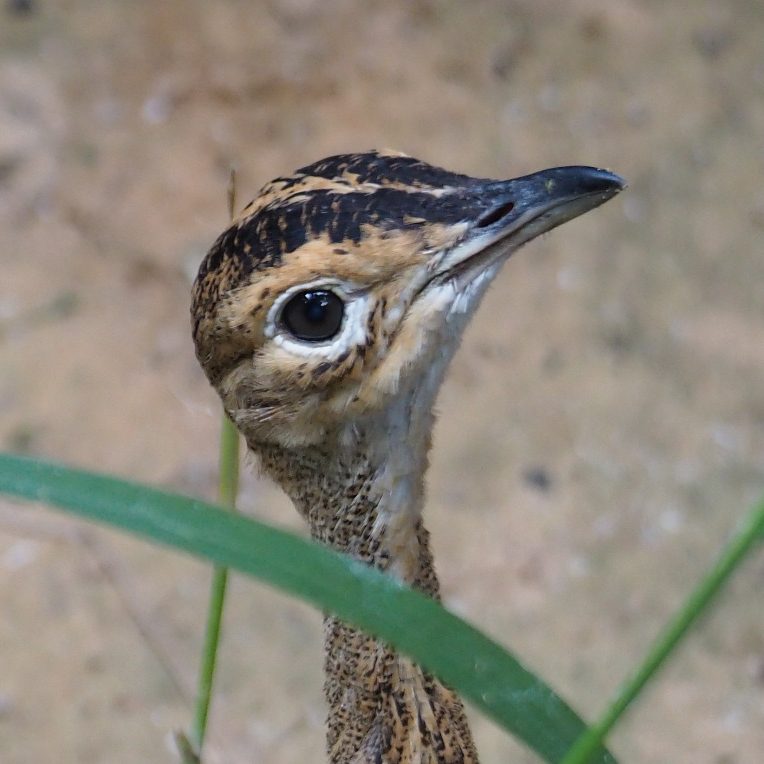
The Bengal florican (Houbaropsis bengalensis), also called the Bengal bustard, is a bustard species native to the Indian subcontinent, Cambodia, and Vietnam. It is listed as Critically Endangered on the IUCN Red List because fewer than 1,000 individuals were estimated to be alive as of 2017. It is the only member of the genus Houbaropsis.
Update November 2025
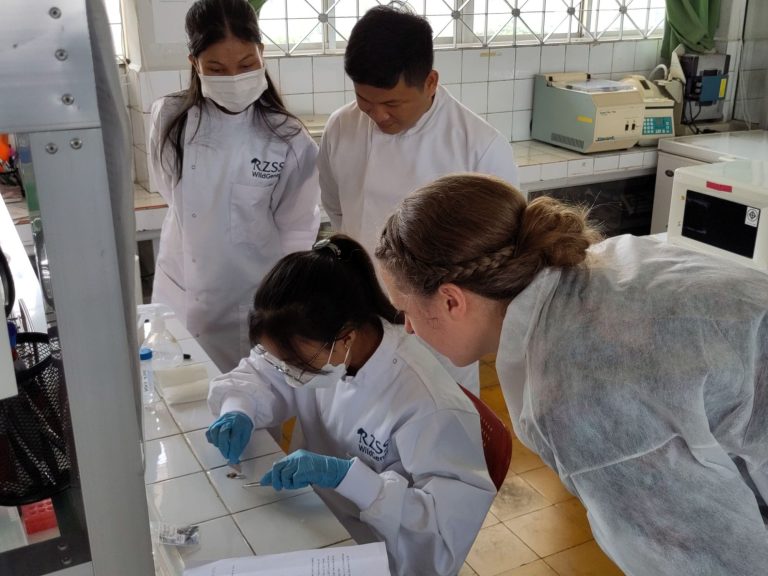
The Angkor Centre for the Conservation of Biodiversity (ACCB), The Royal Zoological Society of Scotland (RZSS) and the Royal University of Phnom Penh (RUPP) have successfully completed the 𝐟𝐢𝐫𝐬𝐭 𝐠𝐞𝐧𝐞𝐭𝐢𝐜 𝐬𝐭𝐮𝐝𝐲 of the critically endangered Bengal Florican (Houbaropsis bengalensis blandini) in Cambodia.
From 22 samples, the project investigated three key conservation questions:
1️) 𝐆𝐞𝐧𝐞𝐭𝐢𝐜 𝐝𝐢𝐯𝐞𝐫𝐬𝐢𝐭𝐲 – very low, with only 629 SNPs identified and a single mitochondrial haplotype. However, the living captive individuals appear representative of the wider wild population.
2) 𝐑𝐞𝐥𝐚𝐭𝐞𝐝𝐧𝐞𝐬𝐬 of the insurance population at ACCB – some individuals are closely related; breeding decisions must minimize inbreeding risk.
3️) 𝐈𝐧𝐝𝐢𝐯𝐢𝐝𝐮𝐚𝐥 𝐢𝐝𝐞𝐧𝐭𝐢𝐟𝐢𝐜𝐚𝐭𝐢𝐨𝐧 – 68 SNP markers were identified, providing a foundation for developing assays to monitor wild populations from feathers or other samples.
Key recommendations include:
- Increasing genetic diversity in the conservation breeding program via additional founders.
- Conducting whole-genome sequencing to better assess inbreeding risk.
- Exploring the genetic relationship with the Indian/Nepalese subspecies for potential genetic rescue.
This project provides essential tools and guidance to support the long-term survival of the Bengal Florican, one of Southeast Asia’s rarest birds and a flagship species for Cambodia’s Tonle Sap inundate grasslands.
Our Bengal Florican conservation efforts are conducted in close collaboration with the Ministry of Environment (MoE) and the Wildlife Conservation Society Cambodia Program. We also thank the Critical Ecosystem Partnership Fund (CEPF) and the The Mohamed bin Zayed Species Conservation Fund for the financial support of this project.
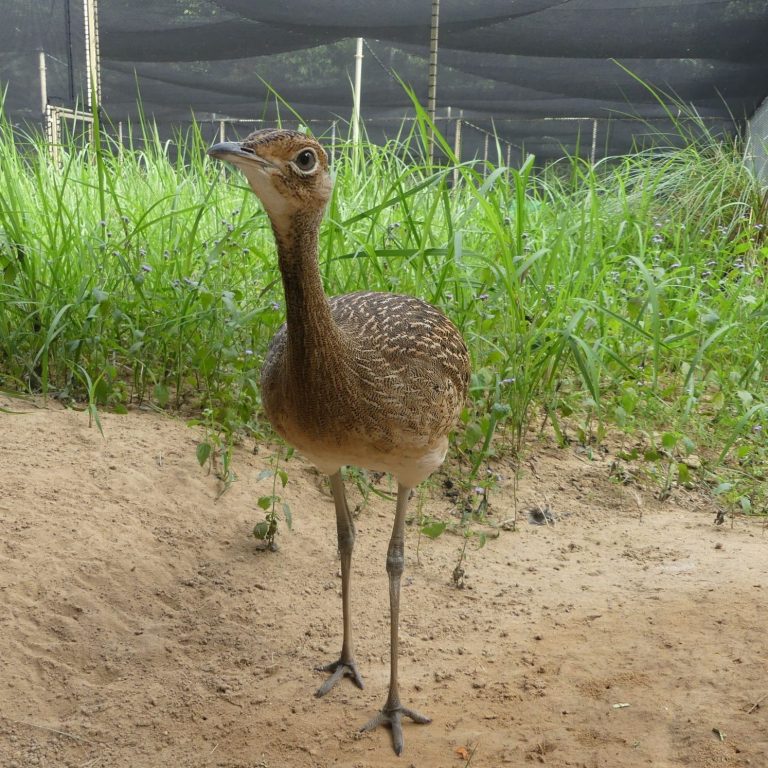
The ACCB, a conservation initiative of Allwetterzoo Münster, is committed to preventing the extinction of the Indochinese Bengal Florican—one of Southeast Asia’s most threatened grassland birds. With the species declining across its natural range, the ACCB is establishing a scientifically managed assurance colony that serves both as a genetic safeguard and as a foundation for future reintroduction efforts.
Science-driven conservation with real-world impact
In 2019, the ACCB created the world’s first ex-situ conservation-breeding colony for this critically endangered subspecies.
Eggs are collected from vulnerable nests in the Tonle Sap grasslands, where burning, flooding, and agricultural expansion pose immediate risks.
At the center, the eggs are incubated under controlled conditions, and chicks are hand-reared to ensure maximum survival—work that combines scientific expertise with dedicated day-to-day care.
Rescue, rehabilitation, and animal welfare
Injured or displaced Bengal Floricans brought in by local communities receive veterinary treatment at the ACCB’s quarantine and rehabilitation facility. Every bird that recovers strengthens the conservation effort—either as part of the breeding population or as a candidate for future release.
Genetics and research guiding long-term survival
In collaboration with partner institutions, the ACCB conducts molecular analyses to evaluate relatedness, manage breeding pairs responsibly, and maintain critical genetic diversity.
These data-driven decisions ensure that the assurance colony remains resilient and capable of supporting future rewilding initiatives.
Supporting habitat conservation on the ground
Although breeding takes place ex-situ, the ACCB works closely with organizations protecting the remaining Bengal Florican grasslands around the Tonle Sap, formally designated as Bengal Florican Conservation Areas.
This integrated approach—linking ex-situ population security with in-situ habitat protection—is essential for meaningful, long-term recovery.
Why support matters
The Bengal Florican is disappearing rapidly, but its future is not yet lost. By contributing to this program, supporters help safeguard eggs and chicks, enable scientific breeding and rehabilitation, and strengthen habitat protection efforts in Cambodia.
Your support helps bridge science, compassion, and action—ensuring that this unique species has a future beyond the brink.
The team at the Angkor Centre for Conservation of Biodiversity (ACCB) is dedicated to providing the highest standard of care for every animal under its protection. Yet even under the best circumstances, accidents can occur—especially when working with young, vulnerable birds learning to take their first flights.
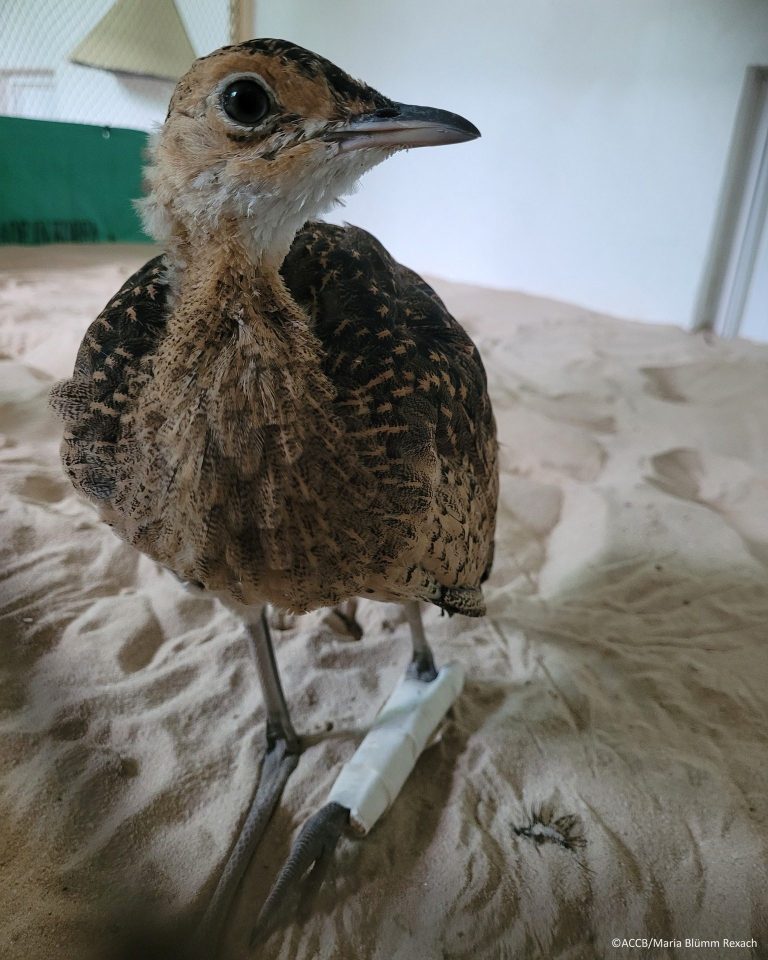
Recently, during our ex-situ management program for the critically endangered Bengal Florican, one juvenile experienced such an incident. While practicing essential flight behaviors, the young bird landed awkwardly and suffered a leg fracture. Despite the logistical constraints and limited access to advanced veterinary resources in the region, our skilled and compassionate team acted swiftly. They stabilized the injury, managed the bird’s pain, and ensured it received continuous, attentive care.
Thanks to their efforts, the juvenile has begun to bear weight on both legs again and has even resumed gentle jumping and early flight practice—carefully and cautiously. Our staff will continue to monitor its progress closely and support its full recovery.
This case posed a particular challenge because Bengal Floricans are highly susceptible to stress-induced myopathy, a potentially fatal muscle disorder. We are therefore especially relieved and grateful that the chick is recovering well. This success is a direct result of the remarkable dedication of our animal care team and veterinary staff in Cambodia.
The ACCB works in close partnership with the Ministry of Environment of Cambodia and WCS Cambodia to safeguard the remaining Bengal Floricans—now numbering fewer than 1,000 individuals worldwide. The Allwetterzoo Münster team joins ACCB staff in extending heartfelt thanks to the Mohamed Bin Zayed Species Conservation Fund, the Critical Ecosystem Partnership Fund (CEPF), the International Union for Conservation of Nature (IUCN), Mandai Nature, the IUCN SSC, and the Asian Species Action Partnership for their vital support of our ex-situ conservation efforts for this imperiled species.
The Bengal Florican is one of the most critically endangered birds in the world. Read how conservationists in Cambodia are desperately trying to save this species from disappearing and why protecting its grassland habitat is crucial.
Wir benötigen Ihre Zustimmung zum Laden der Übersetzungen
Wir nutzen einen Drittanbieter-Service, um den Inhalt der Website zu übersetzen, der möglicherweise Daten über Ihre Aktivitäten sammelt. Bitte überprüfen Sie die Details in der Datenschutzerklärung und akzeptieren Sie den Dienst, um die Übersetzungen zu sehen.