
Angkor Centre for Conservation of Biodiversity
Angkor Centre for Conservation of Biodiversity
The Angkor Centre for Conservation of Biodiversity (ACCB) in Cambodia was founded in April 2003. Based on an idea by Sam Veasna, Jörg Adler and Stephan Goetz founded the ACCB with the help of the ZOOLOGISCHE GESELLSCHAFT FÜR ARTEN- UND POPULATIONSSCHUTZ e.V. (ZGAP) and Roland Wirth.
Since that time, ACCB has been managed by the Allwetterzoo in Münster and has steadily grown into one of the leading species conservation centres in Cambodia. The work of the ACCB focuses on three topics:
01
02
03
Around 40 employees at the ACCB are committed to these issues and care for more than 1,000 animals, 98 % of which represent endangered species.
In 2003, the ACCB was established on a 25-hectare sandy area near Kbal Spean, on the edge of Phnom Kulen National Park. The first infrastructure was built: enclosures, training buildings, and residential buildings were constructed, and the area was fenced in.
First Steps
The most important first milestone was the "Memorandum of Understanding" between the ACCB and the Cambodian authorities. At that time, the ACCB was still located 40 km away from the city of Siem Reap and was only accessible via gravel roads. Today, improved roads lead to Kbal Spean, and the outskirts of the city are slowly reaching the ACCB.
The ACCB was founded as a rescue center but quickly developed into a species conservation center. The first directors were Isabell Stich and Kai-Olaf Krüger. They were followed by Isadora Angarita-Martínez, Markus Handschuh, David Ware, Tobi Bakos, Michael Meyerhoff, and Christel Griffioen. Today, the team has grown to around 40 employees. Initial educational programs in the form of environmental seminars were launched, and series of classes were held in the surrounding village schools.
More than honey
The first major educational program was the "Bee Project," initiated in 2003, which was largely funded by the then German Society for Technical Cooperation (GTZ). The project promoted instructions on the appropriate husbandry of the Asian honeybee, the so-called rafter beekeeping of the giant honeybee, sustainable honey harvesting using local honeybees, appropriate honey processing, as well as quality control and distribution of the products.
Vulture Conservation
Vulture conservation played a major role in the work of the ACCB from an early stage. Due to the sharp decline in vulture populations in Southeast Asia, the remaining populations in Cambodia are of particular importance. In 2007, the ACCB joined the Cambodia Vulture Conservation Project, has conducted annual monitoring programs since then, and operated a vulture restaurant for many years.
But the ACCB also bears responsibility. As the sponsor, the Allwetterzoo covers the running costs from its overall budget, submits funding applications for projects and enclosure construction, and solicits donations from private individuals. Together with the ACCB, it is one of the main employees in the Kbal Spean region and is responsible for approximately 40 families. With the ACCB, the Allwetterzoo also demonstrates what zoological gardens can achieve in species conservation when the political will is present.
Every contribution, no matter the size, helps protect unique wildlife
and its habitats for generations to come.
The Species Conservation Center
In its work as a species conservation center, the ACCB focuses primarily, but not exclusively, on species classified by the IUCN as critically endangered (CR) and found in Cambodia. The focus here is on bird and turtle species.
Focus on Birds
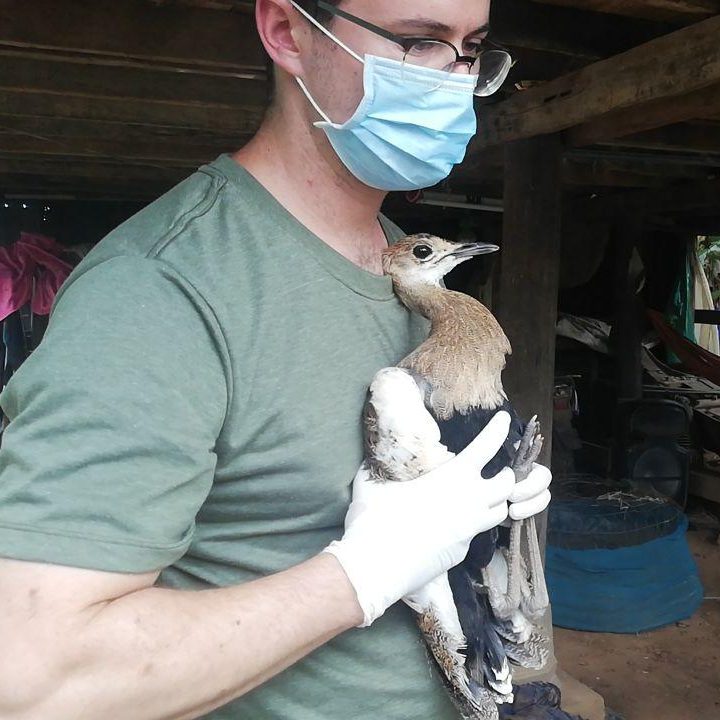
The species kept include the critically endangered species Giant Ibis (Pseudibis gigantea, CR), White-shouldered ibis (Pseudibis davisoni, CR)and Bengal Florican (Houbaropsis bengalensis, CR), as well as the Lesser Adjutant (Leptoptilos javanicus, vulnerable, VU), Asian Woollyneck (Ciconia episcopus, near threatened, NT), and Green Peafowl (Pavo muticus, endangered, EN). The latter two are already regularly bred successfully, and the offspring are reintroduced to protected areas.
The ACCB also maintains several breeding pairs of the Greater Adjutant (Leptoptilos dubius, EN). This once very common bird has become increasingly rare due to habitat loss and is on the verge of extinction. It now breeds only in Assam, India, and Cambodia. For the first time, an Argala pair was able to hatch eggs in 2023. However, attempts to raise the young by the parents failed, and hand-rearing was abandoned.
Focus on Turtles
Studies have shown that 60% of all turtle species are threatened, making them one of the most threatened vertebrate groups. This also explains the high number of turtle species kept at the ACCB.
There are conservation breeding programs for the Elongated Tortoise (Indotestudo elongata, CR) and the Southeast Asian Box Turtle (Cuora amboinensis, EN), whose offspring are already being reintroduced, as well as breeding programs for the Giant Asian Pond Turtle (Heosemys grandis, CR), the Yellow-headed Temple Turtle (Heosemys annandalii, CR), and the Southern River Terrapin (Batagur affinis, CR). Also kept are the Western Black-bridged Leaf Turtle (Cyclemys atripons, EN), Southeast Asian Leaf Turtle (Cyclemys oldhamii, EN), the Mekong Snail-eating Turtle (Malayemys subtrijuga, NT), the Black Marsh Turtle (Siebenrockiella crassicollis, EN), and, rarely, various soft-shell turtles.
Of particular note is the breeding of the Southern River Terrapin, whose Cambodian subspecies was already considered extinct. The ACCB maintains one of the two ex-situ populations and was able to breed its first young in 2022. Just a few weeks earlier, the other ex-situ population produced the world's first breeding.
Other animals at the ACCB
Keeped but not bred are Indochinese Silvered Langurs (Trachypithecus germaini, EN), Pileated Gibbons (Hylobates pileatus, EN), Bengal Slow Loris (Nycticebus bengalensis, EN), Smooth-coated Otters (Lutrogale perspicillata, VU), and various birds of prey, as well as, rarely, the Sunda Pangolin (Manis javanica, CR). All of these animals have in common that they were taken in by the ACCB and not reintroduced because they would not be able to survive in the wild.
In total, the ACCB holds 1,025 individuals from 36 species (as of July 2023).
Wir benötigen Ihre Zustimmung zum Laden der Übersetzungen
Wir nutzen einen Drittanbieter-Service, um den Inhalt der Website zu übersetzen, der möglicherweise Daten über Ihre Aktivitäten sammelt. Bitte überprüfen Sie die Details in der Datenschutzerklärung und akzeptieren Sie den Dienst, um die Übersetzungen zu sehen.